Linked to the evidence
Every point in the summary links to the assessment it came from, so reviewers can check it against the form.

Competency-based education
Elentra runs competency-based education (CBE) on the same record as your curriculum and clinical schedule. Learners, advisors and program directors see progress on Entrustable Professional Activities (EPAs) by stage of development, trend charts drill down to each assessment, and competence committees review the same evidence in their own dashboards.
Stage progress
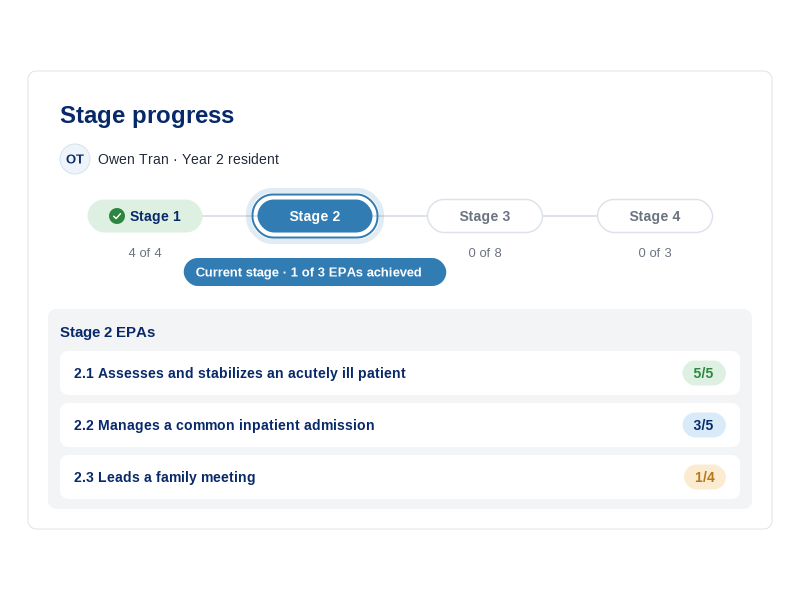
Dashboards group each learner's EPAs by stage of development, along the continuum your program uses, with the assessments recorded for each EPA and how many it needs. Learners see where they stand, and their advisors see the same view.
Assessment trend charts
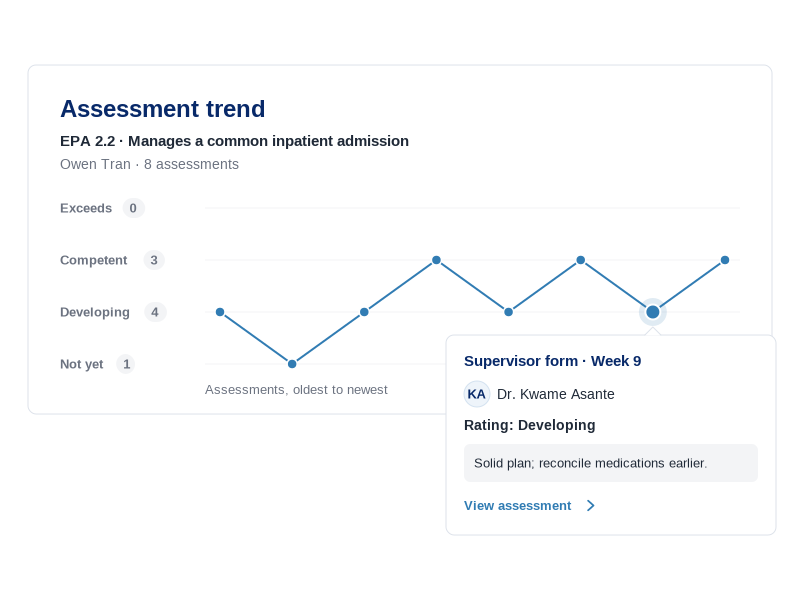
Learners, residents, academic advisors and program directors follow the ratings for one EPA across many assessments in a trend chart. Any point opens the form behind it, with the rating, the assessor and the comment.
Filters
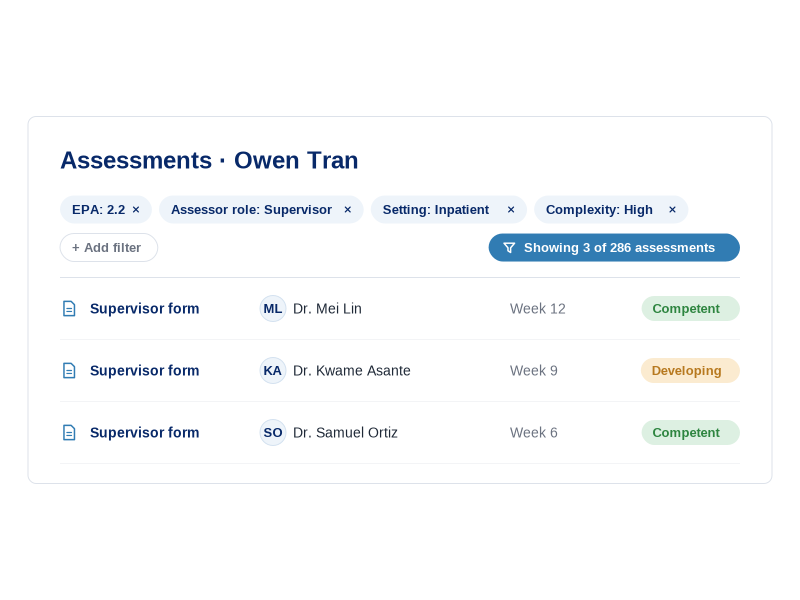
Narrow a learner's assessments by EPA, assessor role, diagnosis, case complexity, clinical setting and the other details your forms record. Advisors find the few observations that answer their question without reading hundreds.
Dashboards
Elentra has dashboards for learners, residents, academic advisors, program directors, administrators and competence committee members. Each one shows the same assessments, organized for the job that person does.
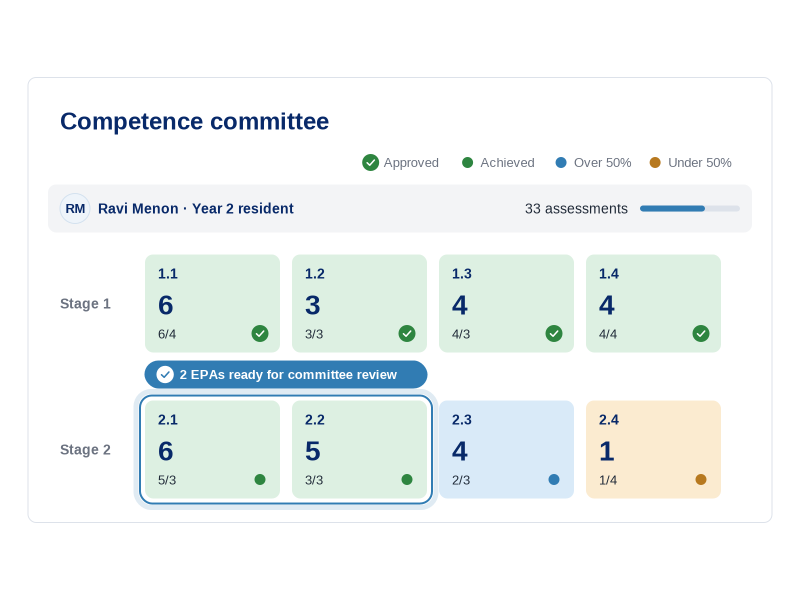
Competence committees review each learner's EPA progress and the assessments behind it in one view. Elentra shows and organizes the evidence; progress decisions stay with the committee.
The team at Elentra has played a pivotal role in the success of our CBME project in Postgraduate Medical Education, helping launch all 29 specialty programs into CBME curriculums. Their commitment to building a true end-user design model that meets everyone's needs has been impressive since we started collaborating in 2015.
AI in Elentra
For each review period, Elentra drafts a summary of a learner's narrative comments across assessments: progress, trends, gaps, and where the evidence is thin, such as few observations or a single assessor.
Every point in the summary links to the assessment it came from, so reviewers can check it against the form.
The summary describes the evidence. Reviewers read it alongside the assessments, and progress decisions stay with them.
Elentra doesn't train AI models on your school's data.
Implementation
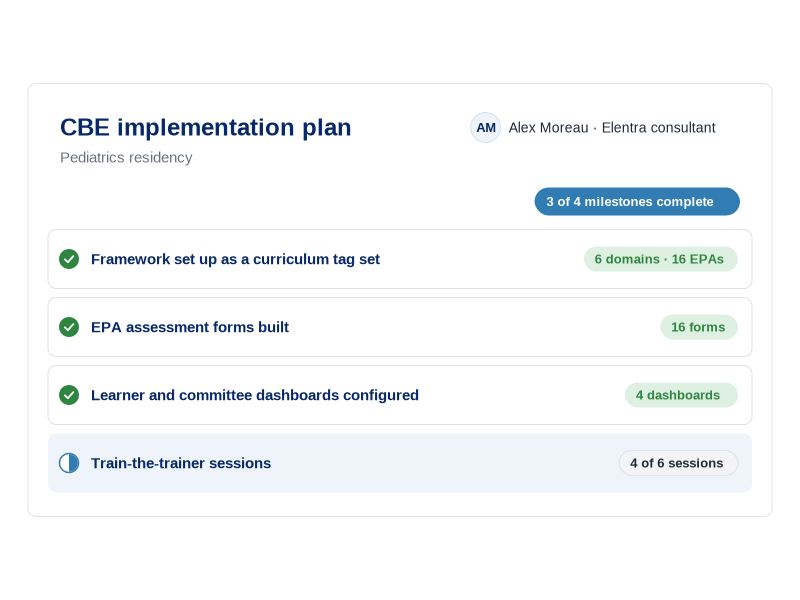
Elentra's roots are in competency-based medical education, and its implementation team has long experience launching CBE programs: turning a framework and its EPAs into curriculum tag sets, assessment forms and dashboards that fit how your program works.
FAQ
Elentra groups each learner's Entrustable Professional Activities (EPAs) by stage of development on their dashboard, with the assessments recorded for each EPA and how many it needs. Trend charts follow the ratings for one EPA over time, and each point opens the assessment form behind it.
Yes. Competence committee members have their own dashboard, showing each learner's EPA progress by stage and the assessments behind it. Committees review the evidence in Elentra, and their decisions stay with them.
No. Elentra shows and organizes the evidence, and progress decisions stay with advisors and competence committees. Elentra's AI drafts summaries of a learner's narrative comments for reviewers, with every point linked to the assessment behind it.
Programs set up their own framework in Elentra as curriculum tag sets, with its domains, competencies and EPAs, and tie assessment forms to it. Elentra's team has supported frameworks in medicine, veterinary medicine, dentistry, pharmacy, nursing and Physician Associate education.