Skip to content

Services

Implementation that works alongside your team

Elentra's Consultative Services team implements Elentra with your program: a dedicated consultant, a structured project plan, hands-on configuration and train-the-trainer sessions. Most institutions go live in four to six months. By launch, your administrators can manage and evolve the platform themselves, and Elentra's support continues as your program grows.

Your implementation team

Consultants who have done the work

Elentra's implementation consultants have worked inside health professions education themselves, in curriculum, assessment, clinical operations and accreditation. They understand the job your staff do, not just the software.

  • 150+

    Years of combined experience

  • About 20

    Years of experience per consultant, on average

  • 4–6

    Months to go-live for most institutions

  • 20–30

    Hours of guided training

People, process, partnership, product

Four parts of every implementation

Every Elentra implementation uses the same method and building blocks, and none is identical. It starts from your curriculum model, your pre-clinical and clinical structure, your governance and your accreditation context.

  • People: consultants who know your field

    Your consultant brings firsthand experience in curriculum management, assessment and evaluation, clinical and education operations, and accreditation and mapping. So the conversation covers your processes, governance and mapping strategy, not only where to click.

  • Process: project management as a service

    Each school gets a dedicated consultant and a shared project workspace. Plans, milestones, roles, risks, testing and leadership reports live in one place, so your project team and your leadership can both see where things stand.

  • Partnership: learn, apply, build

    Your administrators learn each concept with a consultant and apply it straight away in your own Elentra, building skill over time. Train-the-trainer sessions run several times a week during onboarding, on campus, hybrid or fully remote.

  • Product: modules in the order you need them

    Elentra is organized into modules. You launch what your program needs first and add the rest over time, instead of switching everything on at once.

Who does what

The heavy lifting is ours

Your program makes the decisions and supplies the information. Elentra does the configuration and the most labor-intensive build work, and checks each step with you.

What your program brings, and what Elentra handles
Part of the project What your program brings What Elentra handles
People and planning The right people, and decisions on access, curriculum structure, and what you assess and when A structured plan, a schedule and a dedicated project workspace
Data Your data: users, courses, learning events and rotations, gathered with Elentra's templates Translating that data into the platform, including data in spreadsheets or another system
Setup Your program's goals and accreditation context Hands-on configuration, including building your whole clinical rotation lottery
Keeping it moving One internal coordinator to keep decisions moving Guided training and responsive support at every step

The path to go-live

Four to six months, at your pace

Implementation runs as a repeating cycle: gather requirements, build alongside you, review progress together each week, and train your team, until you're ready to launch. You can move faster or more deliberately.

Indicative only. Every program is different, and the timeline depends on how many modules you launch first, how much data there is to prepare, and your team's availability.

  1. Weeks 1–2

    Discover and plan

    Kickoff, scope, project plan, team roles and access

  2. Month 1

    Build the foundation

    Users and curriculum structure; course shells and course websites

  3. Months 2–4

    Configure and populate

    Learning events and clinical rotations, assessments and curriculum mapping, with your data imported through Elentra's templates

  4. Months 4–5

    Validate and train

    Testing, train-the-trainer sessions and super administrator readiness

  5. Months 5–6

    Launch and support

    Go-live, with ongoing consultative support as you grow

What members say

In our members' words

  • One of the best things about working with such an amazing team at Elentra is that it feels like we are the only program they are dealing with whenever we meet. I know this is absolutely not the case, but the sense is that for the time we are working on things together, we have 100% of the team's focus and energy.

    Program Director Canadian Institution
  • We have been very satisfied with the Elentra platform and the team's ability to meet our needs. In my 30 years of experience working with IT solution providers, I believe that the Elentra team has delivered the best customer service and support I have ever experienced.

    Technology Manager U.S. Institution
  • Elentra's Support Team is excellent. They are timely and very helpful. I can't say enough about how they have helped me navigate goals and miscellaneous questions that come up.

    Director, Office of Curriculum U.S. School of Medicine

Competency-based education

Experience with the frameworks you follow

Elentra's roots are in competency-based medical education. Our team has helped programs through the Royal College of Physicians and Surgeons of Canada's Competence by Design, mapping CanMEDS roles across postgraduate specialty programs. We also help undergraduate medical programs align with the AAMC, AACOM and ACGME Foundational Competencies for Undergraduate Medical Education.

The same work extends beyond medicine. Elentra maps to frameworks such as the AAVMC's CBVE 2.0 in veterinary medicine, and to those in dentistry, pharmacy, nursing and Physician Associate education. As standards move toward defined outcomes and Entrustable Professional Activities (EPAs), we help you turn them into working curriculum maps, assessments and accreditation reports.

Elentra also takes part in MedBiquitous, the AAMC's program for shared health professions education data standards, so your curriculum data uses a common vocabulary across systems.

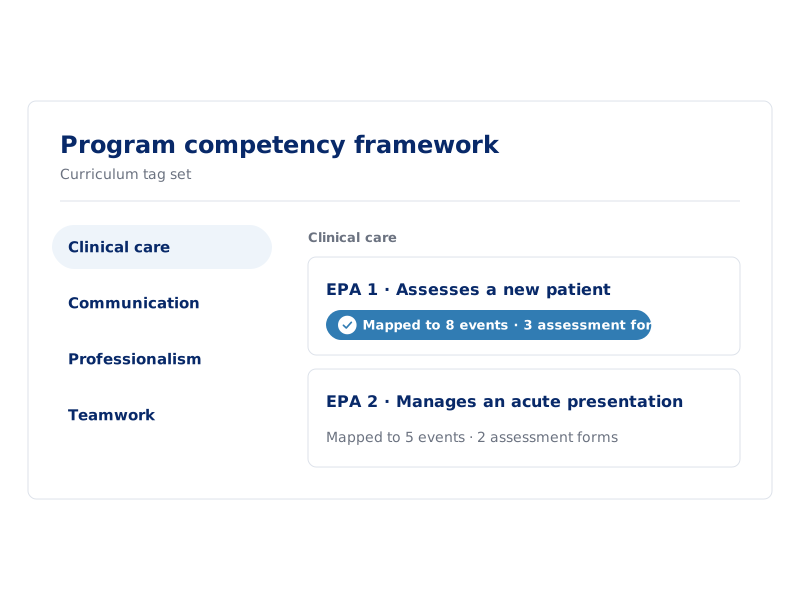
A competency framework set up as a curriculum tag set in Elentra, with two EPAs mapped to learning events and assessment forms.

After go-live

Hosted, updated and supported

Launch is the start of the partnership. Elentra runs the infrastructure so your team can focus on teaching and learning.

  • Cloud hosting

    Each institution runs on its own instance of Elentra, in an industry-standard commercial cloud, with backups handled for you.

  • Your choice of location

    We usually host in the location closest to you, and you can choose any available location.

  • 24/7 emergency cover

    Each account has an assigned emergency contact, at any hour.

  • Always up to date

    Your instance is updated as new versions of Elentra become available.

  • Your data, on request

    You can request a copy of your database to use with your own business intelligence tools.

  • Monthly product meetings

    Member institutions meet with Elentra every month to share practice and shape the platform. Ongoing guidance from our Consultative Services team continues as your needs change.

  • The implementation team are amazing, and the features and use cases fit all of our needs.

    IT Coordinator Canadian Institution

FAQ

Questions about implementation

How long does an Elentra implementation take?

Most institutions go live with Elentra in four to six months. The timeline depends on:

  • how many modules you launch first
  • how much data there is to prepare
  • your team's availability

You can move faster or more deliberately.

How much of our team's time will an Elentra implementation need?

Plan for about 20–30 hours of guided training across the modules you adopt, plus a similar or larger amount of time in working sessions, configuration and data preparation. During onboarding that usually means a few focused sessions a week, paced to fit around everyday work.

Who needs to be involved in an Elentra implementation?

Usually:

  • academic leadership
  • a project lead
  • curriculum and course owners
  • faculty
  • assessment and evaluation leads
  • your clinical and rotations team
  • IT or registrar staff as needed

Clear ownership and timely decisions matter more than headcount. Elentra recommends naming one internal coordinator.

Do we need developers to implement Elentra?

No. Elentra handles the system configuration and the technical work. Your IT or registrar colleagues help with account provisioning, single sign-on and data exports, but your side doesn't need any software development.

What happens to our existing curriculum and data when we move to Elentra?

Elentra provides templates for gathering your users, courses, learning events, rotations and more. Our team then translates that information into the platform. Where your data lives in spreadsheets or another system, we map and import it with you.

Will our team be able to manage Elentra after go-live?

Yes. That's a core goal of every Elentra implementation. Through train-the-trainer sessions, your administrators learn each concept, apply it right away and build skill over time. By go-live they can manage and evolve the platform, and consultative support stays available.

Do we have to launch every Elentra module at once?

No. Elentra is organized into modules, so implementation proceeds in stages. You start with what your program needs first and bring more modules online over time.

What support does Elentra provide after go-live?

During implementation you work with a dedicated consultant and Elentra's Consultative Services team. After go-live the partnership continues:

  • ongoing guidance as your program changes
  • 24/7 emergency cover
  • regular platform updates
  • monthly product meetings with other member institutions